About the soundtrack
All vocalists in the soundtrack for the film From Nomad to Nobody are Tibetan. Tibetan nomads have a rich lore of poetic songs, accompanied by simple instruments such as the dramnyen (six-string Tibetan lute played by plucking the strings) or the piwang (two-string fiddle played upright with a bow). Some sound-bytes from the film:
- Dramnyen Zhabdro
A traditional folk song from the Lhasa area that changes pace half a dozen times in the course of the vocals. Percussion is provided by foot-stomping. From the album Drayang, by the Tibetan Institute of Performing Arts, Dharamsala. Surprisingly, for such an upbeat song, the song makes poetic references to pilgrimage sites like the sacred peak where Milarepa lived (*see note below on Milarepa).
- Mang Lu
Song about the yak-hair tent, used by Tibetans for thousands of years, and specially designed for the harsh environment. The vocals are sung a capella, with some horse and wind sound-effects added in the background. High-spirited yodelling is evocative of life on the grasslands. Vocals by Gonchok Kyab, appearing on the album Shining Spirit, by Jamyang Yeshi.
- Offering to Guru Rinpoche
Guru Rinpoche is a patron deity in Tibet, often invoked with special prayers in times of distress. The Tibetan female singer was originally recorded a capella by musician Victor Chorobik, who later added instrumental backing. Both versions have been blended in the documentary. The song will appear on Victor Chorobik's new album Khorlo, the follow-up to Desert of Clouds (released in 2008).
- Tam Cha
This song is a homage to the Dalai Lama: "the truth of freedom will forever be realised by following you." The instrumental backing blends Tibetan and Western instruments. Original composition by Ngakpa Kalzang Dorje, with vocals by Jamyang Yeshi, from his album Shining Spirit, which goes with a short documentary also called Shining Spirit (directed by Karen McDiarmid), released in 2009. Jamyang Yeshi is from a nomad family: he escaped across the Himalayas in 1998 and found his way via India to Canada. He has toured in Europe and North America.
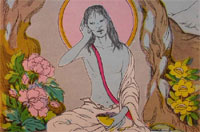
*The 11th-century sage Milarepa never founded any monasteries. Instead, he lived in remote caves, dining on nettle soup, meditating and composing songs. He enlightened his students through music and poetry, and is depicted in temple paintings with his right hand cupped to his ear, to better hear the music of the spheres. He is credited with the poem, Hundred Thousand Songs. And that was a millennium before the iPod!
Tibetan singers jailed after release of songs about self-immolation, Dalai Lama
Two Tibetan singers from Ngaba have been imprisoned for two years each following their release of a music DVD including songs about self-immolations and the Dalai Lama, according to exile Tibetan sources. The prison sentences are consistent with a harsh crackdown against Tibetan artists and writers, which has not prevented more and more Tibetans seeking to express themselves through poetry, blogging, books, painting and song.

Cover photo of the album shows Chakdor (at middle in gold-coloured shirt), Pema Trinley (in maroon shirt on right) and musician Khenrap (on left in black shirt).
Singers Pema Trinley, 22, and Chakdor, 32, from Me'urama nomadic village in Ngaba (Aba) were first detained in July 2012 days after the release of the album, entitled 'The Agony of Unhealed Wounds'. News of their sentencing in February has only emerged recently. Their music DVD included songs in praise of the Dalai Lama, exiled head of Kirti monastery Kirti Rinpoche, and Sikyong Lobsang Sangay, the Tibetan political leader in exile. The singers' families have not been able to see them since they were imprisoned, and their current location is unknown.
A musician called Khenrap and lyricist Nyagdompo who worked on the album have disappeared, according to the Tibetan Center for Human Rights and Democracy. The lyrics of the song on the album about the Dalai Lama refer to him as the 'wish-fulfilling jewel' “Who sees the three times / Is exiled to the ends of the earth / Can [we] forget it from our hearts? / On the summit of the red mountain / The face of snow lion flag / Is engulfed in the darkness / Does that appear in [your] mind's eye?”
The songs also included lyrics about the self-immolations in Tibet, with specific references to the first self-immolations in Tibet, Kirti monks Tapey on February 27, 2009 and Phuntsog on March 16, 2011. According to exile Tibetan sources, Chakdor is a close relation of a young Tibetan man called Chopa who died after he self-immolated on August 10, 2012, in Me'urama, Ngaba.
Tashi Dhondup, a popular Tibetan singer from Amdo, served 14 months in a labor camp after he issued an album of songs in 2009 called 'Torture Without Wounds' containing lyrics that express his pain over the situation in Tibet.
Tibetan singers and writers have been at the forefront of a vibrant literary and cultural resurgence in Tibet since protests against government policy and in support of the Dalai Lama swept across the plateau from March, 2008. Expressions of grief and sorrow to the self-immolations have emerged in both music videos, blogs and poetry, indicating both the significance of the actions as statements, and the developing and resolute sense of Tibetan solidarity and unity across Tibetan areas.
Characterised by some Tibetans in exile as a 'tsampa revolution' — referring to the Tibetan roasted barley staple as a symbol of Tibetan identity that transcends sect and regionalism — a younger generation of Tibetans is developing new strategies and new modes of expression to counter censorship and political repression. Artists create work that employs Tibetan motifs in unconventional ways; rap and hip-hop songs make metaphorical allusions to the Dalai Lama or the Karmapa in exile, and virtual and real 'pure language' communities are created to protect the Tibetan language.
—edited from a post by the International Campaign for Tibet, June 19, 2013